 Skip to content
Classification and Evolution
The nautilus belongs to the genus Nautilus , which in turn is part of the family Nautilidae . This family is the only surviving member of the once very diverse order Nautilida . Currently, several species of nautilus are recognized, with Nautilus pompilius Linnaeus being considered the common nautilus.
Species | Year of Discovery | Status |
Nautilus pompilius | 1758 | |
Nautilus pompilius pompilius | 1758 | |
Nautilus stenomphalus | 1758 | |
Nautilus macromphalus | 1848 | |
Nautilus clarkanus | 1858 | Extinto |
Nautilus cookanum | 1892 | Extinto |
Nautilus belauensis | 1981 | |
Nautilus pompilius suluensis | 1988 | |
Nautilus samoaensis | 2023 | |
Nautilus vanuatuensis | 2023 | |
Nautilus vitiensis | 2023 |
The nautilus is considered a "living fossil" because it has changed very little in the last 450 million years. Its ancestors, the nautiloids, dominated the oceans during the Paleozoic and Mesozoic eras, long before the dinosaurs appeared. While most of its relatives became extinct, the nautilus managed to adapt and survive to this day.

Anatomy and Physical Characteristics
The nautilus possesses a number of unique characteristics that distinguish it from other cephalopods and make it particularly interesting:
Sea Shell
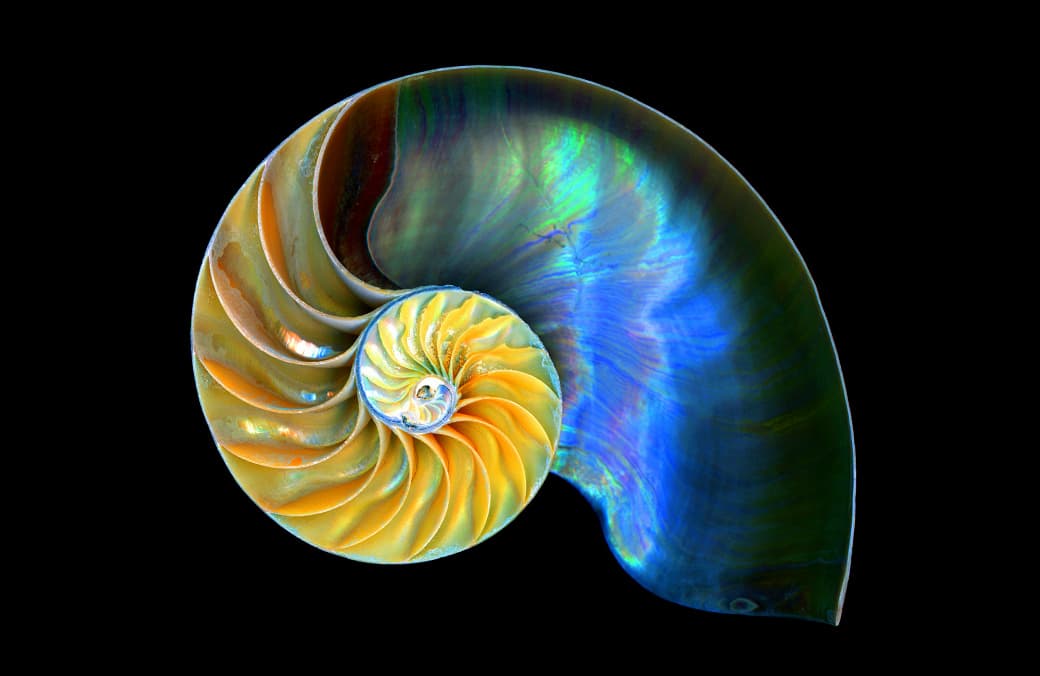
The most striking feature of the nautilus is its spiral shell. Unlike other modern cephalopods such as octopuses and squid , the nautilus has retained its external shell. This shell is divided into chambers, and the animal occupies only the outermost chamber. The inner chambers are filled with gas, allowing the nautilus to control its buoyancy. (Insert image of a nautilus drawing)
The nautilus shell is a perfect example of the logarithmic spiral in nature. It grows proportionally, always maintaining the same shape. The patterns on the shell's surface, with its bands and stripes, serve as camouflage in the ocean depths.
Tentacles
The nautilus has up to 90 tentacles, unlike the 8 or 10 found in other cephalopods. These tentacles don't have suckers, but rather grooves and ridges that allow them to grasp their prey. The tentacles also serve sensory functions and are used for locomotion and feeding.
Eyes
Unlike the complex eyes of other cephalopods, the nautilus's eyes are very simple, similar to those of a pinhole camera. They lack a lens, and light enters through a small hole. Despite this simplicity, the nautilus is capable of distinguishing light from dark and detecting movement.
Propulsion system
Like other cephalopods, the nautilus uses a jet propulsion system. It expels pressurized water through a siphon, allowing it to move backward quickly. This method of locomotion is very efficient and allows it to escape predators.

Habitat and distribution
Nautiluses primarily inhabit the deep waters of the Indo-Pacific, from the coasts of Asia to Australia and the islands of the South Pacific. They can be found at depths ranging from 100 to 700 meters, although they generally prefer deeper waters during the day and ascend at night to feed.
Their typical habitat is coral reefs and continental slopes. During the day, they often hide in crevices and caves to avoid predators. At night, they ascend to shallower waters in search of food.
Behavior and Life Cycle
Food
The nautilus is an opportunistic predator and scavenger. Its diet consists primarily of small crustaceans, fish, and other marine animals. It uses its tentacles to capture its prey and its strong beak to crush it.
Reproduction
The nautilus's reproductive cycle is slow compared to other cephalopods. They reach sexual maturity around 15 years of age. Fertilization is internal, and females lay eggs singly throughout the year. The eggs are large, and embryonic development can last up to a year.
Longevity
The nautilus has an extraordinarily long lifespan for a cephalopod. While most octopuses and squid live only one or two years, nautiluses are thought to live more than 20 years in the wild.
Threats and Conservation
Despite having survived millions of years and numerous mass extinctions, nautilus populations currently face serious threats that endanger the survival of this fascinating "living fossil." These threats include habitat destruction and climate change, but the biggest problem for many is overfishing.
overfishing
Overfishing represents one of the most significant threats to the survival of the nautilus. Unlike many other cephalopods, the nautilus has a slow reproductive rate and late sexual maturity, making its populations particularly vulnerable to overexploitation.
The main reason for overfishing of the nautilus is the international trade in its shells:
The nautilus shell trade poses a serious threat to the survival of these ancient creatures. The shells' natural beauty and unique spiral shape have made them highly sought-after items in the souvenir market, where they are sold as decorative items and jewelry.
Fishing methods, which typically involve baited traps placed on the seabed, can capture large numbers of individuals, including females with eggs, further exacerbating the impact on populations.
Regulations and CITES
Due to concerns about overfishing, several nautilus species were included in Appendix II of the Convention on International Trade in Endangered Species of Wild Fauna and Flora (CITES) in 2016. This inclusion means that international trade in nautilus is now regulated and requires permits that certify that the catch is not detrimental to the survival of the species.
However, enforcing these regulations remains a challenge, especially in remote areas where illegal fishing can continue undetected.
The Nautilus Shell in Culture and Science
The nautilus, with its unique shape and long evolutionary history, has left a significant mark on both human culture and science. In the visual arts, the nautilus shell has been depicted in numerous paintings and sculptures throughout history, symbolizing natural perfection and mathematical beauty.
However, it is in the scientific field where the nautilus has generated the greatest fascination, primarily due to the spiral structure of its shell. This geometric shape, known as a logarithmic or growth spiral, has been the subject of study in mathematics and biology for centuries.
The logarithmic spiral that forms the nautilus shell is a near-perfect example of proportional growth in nature. First described by Descartes and later studied in depth by Jakob Bernoulli, a Swiss mathematician and astrophysicist, this spiral has the unique property of maintaining its shape as it grows (the golden ratio). Bernoulli was so amazed by this characteristic that he requested it be engraved on his tombstone.