 Skip to content


- November 3, 2022
Blue whiting: What is it and how do you cook it?
Blue whiting is a white fish from the cod family . It has an exquisite flavor, low-fat flesh, and provides a high level of nutrition and vitamins. All of this makes it a healthy and delicious fish.
Characteristics of the Blue Whiting
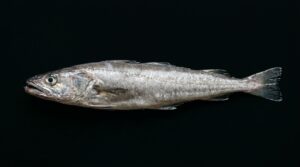
The blue whiting (Micromesistius poutassou) is a fish that belongs to the gadoid family, like cod or pollock.
It is known by many names depending on the fishing area, including: Lirio, Perlita, Bacaladitos or Bacalá.
The blue whiting lives in the Atlantic Ocean, the North Sea, the Cantabrian Sea and the Mediterranean Sea.
It is a fish capable of living at great depths, ranging from 100 to 3.000 meters deep. However, most inhabit depths of 300 to 400 meters.
It feeds on other smaller fish, crustaceans, cephalopods, and other smaller marine species in general. Its diet is entirely carnivorous.
Blue whiting are small fish. Most typically reach a maximum length of 22 centimeters , although in exceptional cases they have been found to be 50 centimeters long. As adults, their minimum length is 15 centimeters.
It has a thin, long and straight body, which only stands out at the belly.
Their colors don't vary much; the blue whiting is bluish-gray, gradually fading to white around the belly. In many cases, they have elongated black spots on the dorsal fins.
The head of the whiting is large, triangular in shape, and has eyes that occupy almost the entire area.
A curious feature of whiting is that they have three widely separated dorsal fins. The first fin is spineless but has 25 white rays. The second dorsal fin, located at the end of the torso, has up to 40 white rays. The last dorsal fin is longer but less prominent than the others.
Its straight line, a sensory organ for detecting water movements, is continuous along its entire body.
In gastronomy, the blue whiting is a white fish highly appreciated for its soft and very pleasant texture.
Being a white fish, it contains quality proteins and a very low percentage of fat. It's also a source of vitamins and minerals.
It is highly recommended to consume blue whiting as part of a balanced and healthy diet.

Curiosities about the Blue Whiting
The name bacaladilla comes from its great resemblance to cod , although in a much smaller size.
These two types of fish should not be confused as they are completely different in flavor, nutritional composition, and texture.
A great curiosity about whiting is that it's a very aggressive and voracious fish. It tends to attack any prey it encounters and often kills more prey than it needs to feed itself.
Nutritional values
The barnacle is a very tasty and easy-to-cook seafood, ideal for anyone who loves seafood.
| Per 100 g of edible portion | |
| Energy (Kcal) | 76 |
| Proteins (g) | 17.4 |
| Total lipids (g) | 0.7 |
| Saturated FA (g) | 0.18 |
| Monounsaturated fatty acids (g) | 0.08 |
| Polyunsaturated fatty acids (g) | 0.28 |
| v-3 (g) | 0.244 |
| C18:2 Linoleic (v-6) (g) | Tr |
| Cholesterol (mg/1000 kcal) | 46 |
| Carbohydrates (g) | 0 |
| Fiber (g) | 0 |
| Water (g) | 81.9 |
| Calcium (mg) | 16 |
| Iron (mg) | 0.3 |
| Iodine (µg) | 30 |
| Magnesium (mg) | 23 |
| Zinc (mg) | 0.4 |
| Sodium (mg) | 77 |
| Potassium (mg) | 320 |
| Phosphorus (mg) | 218 |
| Selenium (µg) | 28 |
| Thiamine (mg) | 0.08 |
| Riboflavin (mg) | 0.07 |
| Niacin equivalents (mg) | 4.9 |
| Vitamin B6 (mg) | 0.33 |
| Folates (µg) | 12 |
| Vitamin B12 (µg) | 2 |
| Vitamin C (mg) | Tr |
| Vitamin A: Eq. Retinol (µg) | Tr |
| Vitamin D (µg) | Tr |
| Vitamin E (mg) | 0.44 |
**It is important to note that these values may vary slightly depending on the quality and freshness of the cod.

Habitat
Blue whiting inhabit temperate waters of the Atlantic Ocean, North Sea, Cantabrian Sea and Mediterranean Sea.
They normally prefer to live on sandy bottoms, but can be found sporadically in the coastal area.
Whitings are usually found at a depth of 300 to 400 meters, except at night when they ascend to feed.
This fish is constantly on the move. They not only migrate upwards to feed, but also during reproductive periods. These migrations are north-south and are aided by ocean currents.
Blue whiting move in large schools , especially during the summer months.
Since it is a fish that almost rises to the surface at night, it is much easier to catch it during those hours.
Season and Fishing Gear
Whiting Fishing Season
Blue whiting can be caught year-round, although it is most common during spring and summer.
As it is a fish of temperate waters, it is more difficult to catch it in the colder months.
However, you can buy blue whiting year-round for regular consumption at a fairly low price.
Blue whiting is caught in large quantities over many months and without much difficulty, which is the main reason why it can be purchased at low prices.
How to fish these white fish
Two types of nets are used to catch blue whiting: trawls and purse seines . Bottom longlines are also used .
Depending on the time of fishing and the season, one or the other is used.
Purse seines are used to fish for whiting at medium depths, while trawls are used when they are on sandy bottoms.
Bottom longlines are less frequently used but are suitable for this type of fish.
It consists of a baited hook line that can be tens of kilometers long and is placed on the seabed.
Blue whiting is a fish that is caught in large quantities, regardless of the fishing method chosen.
How to cook blue whiting?
Blue whiting can be cooked in a variety of ways, as is the case with most fish and shellfish.
It is a very versatile product and suitable for a healthy , protein-rich diet.
This product can be purchased frozen, as is the case with hake and cod, so that it's available whenever we need it.
Blue whiting is a white fish and typically measures between 15 and 30 centimeters, making it a good candidate for frying or coating in flour.
The flesh of the whiting is not very firm, so you have to be careful when handling , preparing and cooking it.
You can prepare blue whiting crumbs to incorporate into rice dishes, stews, or fish meatballs. Its meat is ideal for these types of preparations.
It has a very mild flavor, so any side dish will pair well with its flavor.
The most typical recipes for cod are: grilled, fried, steamed, en papillote, or baked.
Although you can innovate and integrate it into a white fish stew or creamy rice with blue whiting crumbs.