 Skip to content
What do these numbers really mean? Is it an internal code or something we should consider before paying? FAO stands for the Food and Agriculture Organization of the United Nations . While it might sound bureaucratic, these numbers are key to knowing whether the fish you're about to eat comes from the Galician coast or has traveled thousands of kilometers from the Pacific. Let's get down to business! We'll explain how to decipher these codes to make a more conscious purchase.
What does FAO mean and why are there numbers on my fish?
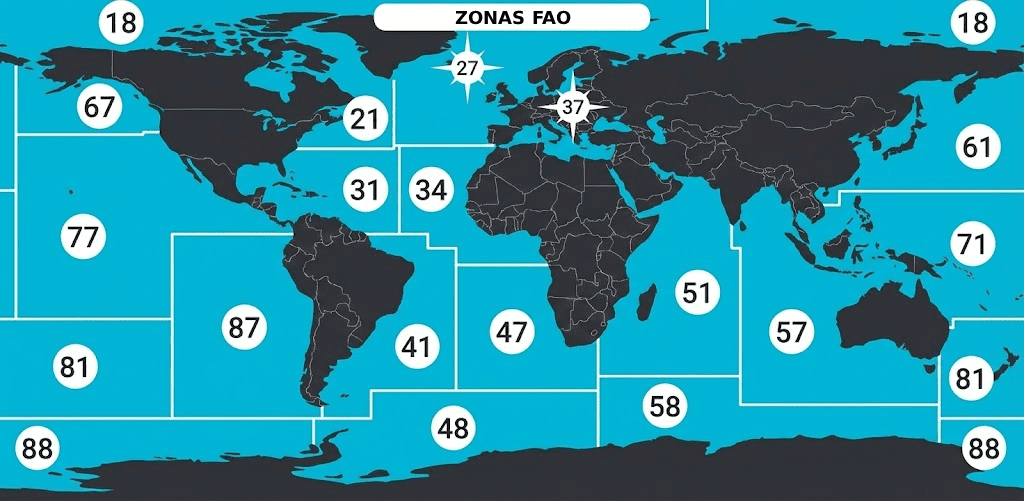
To understand the meaning of FAO or to answer the question " what does FAO mean " on a label, we have to look at the sea as if it were a political map. Since the ocean is immense and fish don't recognize borders, the FAO divided the planet's bodies of water into large statistical areas.
Each of these areas was assigned a number. This system allows:
- Monitor global catch statistics.
- Monitor the status of fish populations.
- To assist in international fisheries management.
Therefore, when you see that number, it's not just an administrative detail; it's the origin registration that tells us which part of the ocean your purchase comes from.
The importance of traceability: What are these zones for?
This is where you, as the consumer, come in. Traceability is the trail that food leaves from the sea to your table. In the European Union, the labeling of fishery and aquaculture products aims to provide clear information, which is why it's common to find the catch area indicated on wild fish.
Knowing how to interpret these codes is useful for two fundamental things:
- Estimated origin and transport: Knowing whether your fish comes from the nearby Atlantic or from distant international waters.
- Security and trust: It ensures that the fish has entered through regulated commercial channels.
Note! This applies mainly to wild-caught fish. If it is farmed, the label usually indicates the country of origin rather than the FAO area.
The most common FAO zones in fish shops in Spain
If you regularly shop in Spain, you'll notice certain numbers that keep coming up. These are our prime " FAO zones in Spain ," the ones that supply most of our fish markets. Take note, this is important!
FAO Catch Area 27: The Northeast Atlantic
This is the queen of fishing labels in our country. The FAO 27 fishing area covers a vast region that includes the Cantabrian Sea, the waters of Galicia, the Bay of Biscay, the North Sea, and extends to the cold waters of Iceland and Norway (Great Sole).
If you see the number 27 on hake , bonito, mackerel, or sardines, it indicates geographical proximity . It's usually fish from our local area or from our European neighbors. While the final freshness depends on maintaining a proper cold chain and the preservation method, the shorter transport distance works in this product's favor.
FAO Area 37: Our beloved Mediterranean
The other major area is Zone 37. It encompasses the entire Mediterranean Sea and the Black Sea, from the Strait of Gibraltar to the coast of Türkiye.
It is the code you will find on the seasonal coastal fish typical of our Levante and South: anchovies, red prawns, wild sea bream or red mullet.
The Pacific map: What do zones 61, 71 and 77 mean?
Sometimes, especially in the frozen, canned, or prepared seafood section (like surimi), you'll see higher numbers. This is where the Pacific Ocean and large international fleets come into play. Let's see what FAO 61 , FAO 77, and FAO 71 tell us.
FAO 61: The Northwest Pacific
FAO Area 61 corresponds to the waters near Russia, Japan, and China. It is one of the most productive fishing areas in the world. This code is commonly found on packages of squid , giant squid, pollock (frequent in surimi sticks), and some types of wild Pacific salmon.
FAO 71 and 77: The Central Pacific
If we move towards warmer waters, we find these two zones:
- FAO 71 (Central-West Pacific): Tropical waters near Southeast Asia.
- FAO 77 (Central-Eastern Pacific): Waters near the west coast of America (from California to Peru).
What fish come from here? Primarily large migratory species. According to the FAO , tuna species (such as the genus Thunnus ) are a key resource in these waters. Much of the tuna we find in frozen loins or canned goods comes from these tropical areas, where species like yellowfin tuna ( Thunnus albacares ) and bigeye tuna are abundant.
How to read fish labels like an expert
Now that you know the codes, the next time you go shopping, pay attention to the label. To read it like a pro, look for these common details that will give you the key information:
- Trade and scientific name: (e.g., European hake, Merluccius merluccius).
- Method of production: It usually indicates whether it is "Wild" (extractive fishing) or "Aquaculture" (farmed).
- Capture zone: Here you will look for your “FAO 27” or the corresponding number. If it is from a farm, it will show the country of origin.
- Fishing gear: Indicate how the fish was caught (trawling nets, lines and hooks, traps, etc.).
One extra tip: Check carefully if the word "Defrosted" appears. Sometimes we see fish on ice at the counter that looks fresh, but the label should indicate if it has been previously frozen.
Quick checklist for your next purchase:
- Are you looking for proximity? Check if it says FAO 27 (Atlantic) or FAO 37 (Mediterranean).
- Is it canned tuna? You will probably see areas of the Pacific (71, 77) or Indian (51, 57).
- Wild or farm? If it says a country (e.g., "Raised in Norway"), it's farmed. If it says "FAO", it's wild.
Why should you check the FAO zone before buying?
Looking at FAO food zones isn't just a matter of curiosity; it's an act of responsibility. Choosing products from zone 27 or 37 when you live in Spain usually means supporting local fishing fleets and often reducing the distance food travels to your plate, which can contribute to a smaller carbon footprint in transportation.
However, fish from distant areas (like the Pacific) is perfectly safe and necessary to meet demand, especially in canned and frozen products. The key is information: knowing what you buy empowers you to decide what kind of consumption you want to support.
Frequently Asked Questions (FAQ)
Are all FAO areas marine?
No, there are also FAO designated areas for inland waters (rivers and lakes) on different continents. However, in supermarkets, it's much more common to see the numerical codes associated with marine fisheries.
Is fish from zone 27 better than fish from zone 61?
Not necessarily in terms of nutritional quality or safety, as both must comply with health regulations. But if you live in Spain, fish from zone 27 has traveled a shorter distance, which means it's more likely to arrive fresher if sold unfrozen.
Does farmed fish also have an FAO zone?
The numerical catch zone code is generally not used. In aquaculture, regulations focus on indicating the country where the fish was raised (e.g., "Raised in Spain"), reserving FAO numerical zones for wild-caught fisheries.