 Skip to content
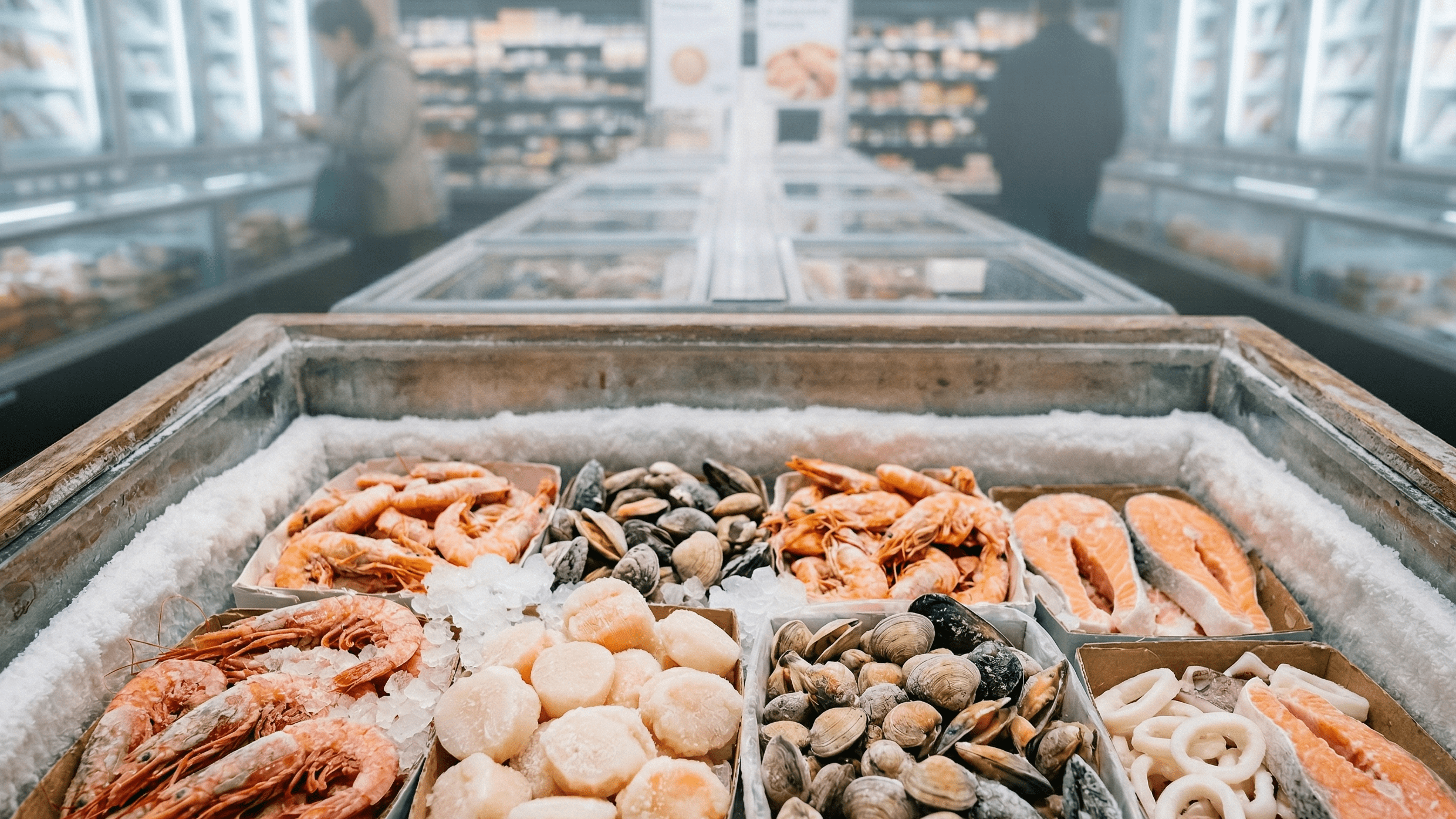
In this guide we explain how long each type of frozen seafood lasts, how to tell if it has lost quality, the difference between home freezing and commercial flash freezing, and the best tips to keep your seafood in perfect condition for as long as possible.
Expiration date vs. best before date: the first thing you should know
Before getting into the timings, it's important to clear up a very common misconception:
- Expiration date: Indicates the food safety limit. After this date, the product should not be consumed. It is used on highly perishable foods (fresh meat, fresh fish, dairy products).
- Best before date: This indicates the date until which the manufacturer guarantees the product's optimal quality. After this date, frozen seafood remains safe, but may have lost texture, flavor, or other properties.
Commercially frozen seafood has a "best before" date, not an expiration date. This means that a package of prawns a month past that date is not dangerous, although the texture may not be ideal.
The key is maintaining the cold chain: if seafood has been kept consistently at -18°C or lower, it retains its food safety for a long time. What gradually deteriorates is its sensory quality (flavor, texture, juiciness). You can learn more about the differences between deep-frozen and frozen seafood on our blog.
Table of shelf life of frozen seafood by species

The times indicated below refer to seafood stored at -18°C or lower, which is the minimum recommended temperature for a domestic freezer. If your freezer does not reach this temperature or experiences frequent fluctuations, the times will be reduced.
Crustaceans
Species | Home freezing | Commercial deep-frozen |
Raw prawns / shrimp | 4-6 months | 10-12 months |
Cooked prawns / shrimp | 2-3 months | 4-6 months |
Raw prawns | 4-6 months | 10-12 months |
Raw lobster | 4-6 months | 8-10 months |
Cooked spider crabs / king crab | 2-3 months | 4-6 months |
Cooked crab | 2-3 months | 4-6 months |
If you're wondering what the difference is between shrimp and prawns , we'll tell you in another article.
Bivalve mollusks
Species | Home freezing | Commercial deep-frozen |
Mussels (in the shell) | 2-3 months | 4-6 months |
Clams | 2-3 months | 4-6 months |
Scallops | 3-4 months | 6-8 months |
Cockles | 2-3 months | 4-6 months |
Razor Shells | 2-3 months | 4-6 months |
Cephalopods
Species | Home freezing | Commercial deep-frozen |
Octopus | 4-6 months | 8-12 months |
Squid / Cuttlefish | 4-6 months | 8-12 months |
Cuttlefish / Cuttlefish | 4-6 months | 8-10 months |
Fish (reference)
Species | Home freezing | Commercial deep-frozen |
Hake / Cod (white fish) | 6-8 months | 12-24 months |
Salmon / Tuna (oily fish) | 3-4 months | 6-10 months |
Snuff | 6-8 months | 12-18 months |
Important note: Oily fish (salmon, tuna, mackerel, sardines) don't last as long in the freezer as white fish because their higher fat content makes them more susceptible to oxidation. This is precisely why they are the fish with the most omega-3 fatty acids, but this healthy fat also oxidizes more quickly.
How to tell if frozen seafood has lost quality
Even if it's within the indicated date, there are visual and sensory signs that warn you that the seafood has lost quality:
ALT TEXT: Signs that frozen seafood has lost quality: freezer burn, ice crystals, and odor
Freezer burn
This is the most common sign. It appears as white or grayish spots on the surface of the seafood, giving it a dry and dehydrated appearance. This occurs when the packaging is not airtight and the dry air in the freezer draws moisture from the food.
Seafood with freezer burn is still safe to eat, but the texture will be stringy, dry, and less flavorful in the affected areas. If the burn is minor, you can trim off the affected areas and cook the rest as usual.
Large ice crystals inside the container
If you find thick blocks of ice or a significant layer of frost when you open the package, it's a sign that the seafood has been subjected to temperature fluctuations during storage. The water in the product has partially thawed and refrozen, forming large crystals that damage the cell structure.
This directly affects the texture: when defrosted, the seafood will lose more liquid than normal and will become softer and more watery.
Unpleasant smell when defrosting
Frozen seafood in good condition has virtually no smell (or only a very faint sea smell). If you notice a strong, ammonia-like, or "stale fishy" smell after defrosting, do not eat it. This smell indicates that the cold chain was broken. Learn how to properly defrost fish and seafood to maintain its quality.
Color change
- Prawns/shrimp: If the flesh is yellowish or the shell has lost color, it is a sign of dehydration.
- Cephalopods (squid, octopus): If they have brown or pinkish spots that are not natural to the animal.
- Fish: If the flesh has changed from pearly white to a dull yellow tone.
Home freezing vs. commercial flash freezing: why it lasts longer

The difference in preservation times between home freezing and commercial flash freezing is not accidental. It is due to a radically different process:
Home freezing
- Temperature: Your home freezer operates at around -18 °C (if it is properly regulated).
- Freezing speed: Slow. Seafood takes hours to freeze completely.
- Ice crystals: Large ice crystals form that pierce the food cells. Upon thawing, more liquid is lost, and the texture suffers.
- Result: Acceptable preservation for months, but with progressive loss of quality.
Commercial ultra-freezing (like that of Delfín)
- Temperature: It is carried out at -40 °C or lower, often directly on board the fishing vessel.
- Freezing speed: Ultra-fast. Seafood freezes in minutes, not hours.
- Ice crystals: Microscopic crystals are formed that do not damage the cell structure.
- Result: The seafood retains its texture, flavor, nutritional value and juiciness in a way that is virtually identical to fresh seafood for much longer.
That's why a prawn that's been flash-frozen on board can be kept in perfect condition for 12 months, while the same prawn frozen at home after buying it "fresh" at the fishmonger's will start to lose quality after 4-6 months.
Discover more about how to properly freeze fish at home to maximize its shelf life.
What if the frozen seafood is "expired"? Can I eat it?
Let's get to the million-dollar question. If your frozen seafood has passed its best-before date but has always been kept at -18°C or lower:
- Is it safe? Generally, yes. Continuous freezing at -18°C or lower inhibits the growth of pathogenic bacteria. According to the Spanish Agency for Food Safety and Nutrition (AESAN), properly frozen foods do not present a microbiological risk as long as the cold chain is maintained.
- Will it be the same quality? Probably not. Over time, seafood undergoes lipid oxidation (especially oily fish), surface dehydration, and loss of texture.
Our recommendation: Always respect the best before date to enjoy seafood at its best. If you find a package that's slightly past its expiration date (1-2 months), assess its appearance before discarding it: if it doesn't have freezer burn, large ice crystals, or a strange odor when thawed, it's probably still safe to eat.
7 tips to make your frozen seafood last longer

Keep the freezer at -18°C or lower
This is the minimum temperature recommended by European regulations. If your freezer has a numerical control, set it to the coldest setting. Many domestic freezers do not consistently reach -18°C, especially those integrated into the refrigerator.
From the moment you buy frozen seafood until you store it at home, the time it spends out of the freezer should be as short as possible. Use insulated bags for transport and put it in the freezer as soon as you get home.
Use airtight containers
If you transfer the seafood to another container, make sure it's airtight and that as little air as possible remains inside. Air is the main enemy: it causes oxidation and freezer burn. Vacuum bags are the best option if you have a vacuum sealer.
Label each package with the date
It seems obvious, but almost no one does it. Write the freezing date (if you freeze it yourself) or the purchase date on the packaging with a permanent marker. That way you'll know exactly how long each product has been in the freezer.
It uses the FIFO system: first in, first out
Place the newest products at the back and the oldest at the front. This way, you'll always use the oldest seafood first, preventing forgotten packages from accumulating at the back of the freezer.
Don't open the freezer unnecessarily
Every time you open the door, warm air enters, causing a rise in temperature and frost to form. Try to plan what you need before opening it to minimize the time it's open.
Never refreeze seafood that has already thawed.
Once seafood has thawed, you should never refreeze it raw. Double freezing severely deteriorates the texture and can compromise food safety. Learn the best techniques for properly thawing prawns and shrimp.
Exception: If you defrost raw seafood and cook it, you can freeze the cooked result. For example: defrost raw shrimp, cook them, and freeze the cooked shrimp. This is safe.